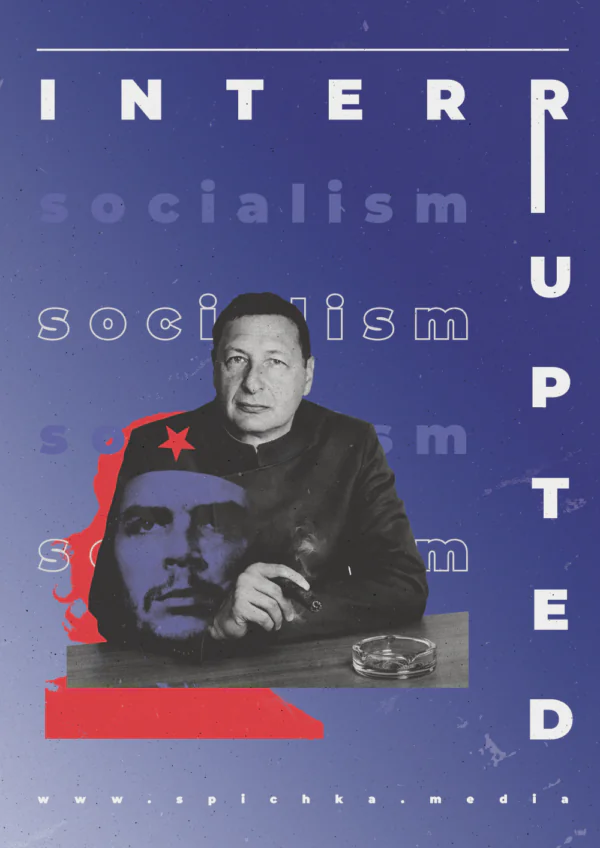
Socialism: the missed chance
Содержание
What should we choose: a terrible end, or terror without end? — Kagarlitsky on capitalism
18+ НАСТОЯЩИЙ МАТЕРИАЛ (ИНФОРМАЦИЯ) ПРОИЗВЕДËН, РАСПРОСТРАНËН И (ИЛИ) НАПРАВЛЕН ИНОСТРАННЫМ АГЕНТОМ КАГАРЛИЦКИМ БОРИСОМ ЮЛЬЕВИЧЕМ ЛИБО КАСАЕТСЯ ДЕЯТЕЛЬНОСТИ ИНОСТРАННОГО АГЕНТА КАГАРЛИЦКОГО БОРИСА ЮЛЬЕВИЧА.
18+ THIS MATERIAL (INFORMATION) WAS PRODUCED, DISTRIBUTED, AND/OR SENT BY FOREIGN AGENT BORIS YULIEVICH KAGARLITSKY, OR CONCERNING THE ACTIVITIES OF FOREIGN AGENT BORIS YULIEVICH KAGARLITSKY.
The crisis of capitalism does not, by itself, lead to socialism. We will live in an endless crisis.
“This is all clear. But what are we supposed to do?”
— Build a left coalition.
We study the interests of the working class together with Boris Kagarlitsky. Read how socialists in Chile and Czechoslovakia could have changed the world, but were stopped by tanks in the streets.
Preface by /spichka
In his new article, Boris Kagarlitsky returns to the matter of socialism raised in his earlier text on the vision of the future, while also developing his ideas from Between Class and Discourse and The Long Retreat.
Neoliberal reforms permanently changed capitalism. Only now can we see the full scale of these transformations.
The bourgeoisie’s new approach is to live in a permanent crisis rather than eliminate its causes.
Society is becoming atomized. Bonds are breaking down.
Under these conditions, the Left weakens while the far right grows stronger.
Read Boris Kagarlitsky’s new article and take part in a discussion about the socialism that everyone would like to build.
1968–1973: Humanity’s missed chance
From Che Guevara to Pinochet
In 2017, the British culturologist Mark Fisher1/spichka: Mark Fisher (1968–2017) was a British left-wing culturologist. He received his PhD in 1999.
Fisher became widely known after the publication of Capitalist Realism: Is There No Alternative? (2009). By “capitalist realism”, he meant the belief that capitalism is the only viable system and that there is no alternative to it.
In 2017, Fisher died by suicide after many years of struggling with depression. began teaching a course at Goldsmiths, University of London, titled “Postcapitalist Desire”. After delivering five lectures, he handed out assignments for the sixth class, returned home, and hanged himself.
I admit that joking about such things is hardly appropriate, but it seems absolutely unacceptable to me to die by suicide without finishing a course. More importantly, the lecture that remained undelivered was, in my view, the most interesting one: “The Destruction of Democratic Socialism and the Origins of Neoliberalism in the Case of Chile”. We can get some idea of what Fisher wanted to say from the remarks he made in the introductory class and throughout the other lectures, which have been published2Fisher, M. (2021). Postcapitalist Desire: The Final Lectures. Repeater Books.. These ideas are important and very close to my own. I would like to develop them further and bring the argument to its conclusion. That is what I will try to do in this article — though, of course, from my own perspective and experience, political as well as emotional.
Pinochet killed democratic socialism in Chile. The neoliberal era began with him.
The 1973 coup in Chile, when the military under General Pinochet overthrew the left-wing government of Salvador Allende3/spichka: Salvador Allende (1908–1973) was a Chilean socialist politician. He ran for president several times. In 1970, Allende won the election and became the president of Chile.
He ran as the candidate of the Popular Unity coalition, which at different times included as many as nine parties. The largest were the Socialist Party of Chile, the Communist Party of Chile, and the Radical Party. The first two were Marxist; the latter stood for reformism and social democracy.
Allende himself belonged to the Socialist Party, the most radical party in the coalition.
After coming to power, Allende began a program of radical reforms. He nationalized many enterprises, some of them U.S.-owned, which was one of the reasons Chile came under pressure from the United States.
In September 1973, Pinochet carried out a military coup. During the assault on the presidential palace, Allende died by suicide.
Some members of his government managed to escape. Most settled in Cuba or East Germany., followed by a wave of bloody reprisals against the defeated, was not only an event in Latin American history. It marked the end of an entire period: brief, but brilliant, filled with attempts at radical transformation in very different parts of the world, from Czechoslovakia to Peru, and from France to the United States. Their forms and scale differed, but they were united by a shared need to overcome the conservative equilibrium of the world and break through to a new prospect of development — democratic socialism4/spichka: Supporters of democratic socialism understand the term in different ways. What unites them is that “democratic socialism” is contrasted with the Soviet system..
Of course, all these attempts had a background, first and foremost connected to the fact that the models of development that had triumphed in both East and West had clearly exhausted their positive potential by the end of the 1960s. It would be entirely wrong to think that the revolutions of 1968–1973 were produced by the failures of earlier development. Not at all. The opposite was true.
The competition between the two systems was improving the lives of workers on both sides.
At first, the rivalry between the two systems had a beneficial effect on the social position of working people in both developed capitalist countries and states ruled by communist parties. Consumer society was triumphant everywhere, though it took different forms: for some, cheap family cars; for others, cramped but individual apartments replacing communal flats and barracks.
Since 1945, Europe has lived without wars. Sadly, the same could not be said about Asia, where a new phase of the decades-long war in Vietnam followed the Korean War. Still, this was a far cry from the global conflicts of the first half of the 20th century.
Changes were also taking place in the Third World. Colonies gained independence one after another, and the new governments, though often entirely indifferent to civil liberties and human rights, nevertheless launched literacy campaigns and industrialization programs. They sought assistance either from their former colonizers or from the Soviet bloc — and often from both at the same time.
The Cuban Revolution sparked hopes for change in Latin America.
Across Latin America, hopes for change surged after the Cuban Revolution of 1959. And although by the mid-1960s the first doubts had begun to emerge about what was happening on the Island of Freedom — it was, after all, hardly accidental that the legendary comandante Che Guevara preferred the doomed Bolivian expedition to a government career under the new authorities5/spichka: After the victory of the Cuban Revolution, Che Guevara first became president of the National Bank and later minister of industry. In 1965, he left his post to support guerrillas in Congo; in November 1966, he went to Bolivia, where he was killed in October 1967.
Why exactly Che Guevara decided to leave Cuba and continue the guerrilla struggle remains a matter of debate. — enthusiasm and hope nevertheless remained intact. And not only among the Left.
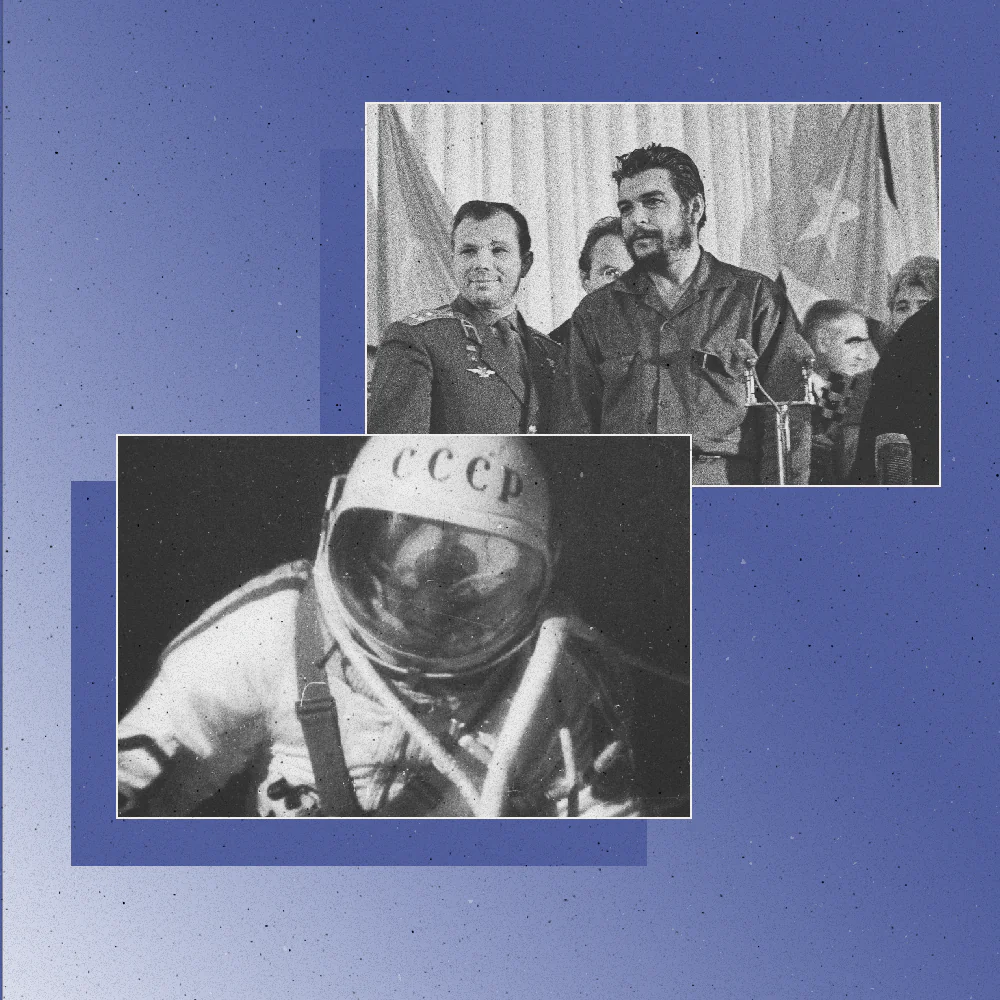
Without much exaggeration, one could say that the 1960s were the “good times”. Perhaps more than ever before, humanity — or at least a considerable part of it — was beginning to feel like a single whole. The explosive success of science fiction captured this orientation towards the future and the desire to discover new worlds: not necessarily on another planet, but by overcoming the limits of everyday life through technological progress, which should logically have been followed — not without problems and contradictions — by social progress as well.
By the mid-1960s, Keynesianism in the West and the Soviet model of socialism had given people as much as they could. Reforms were needed.
The problem was that, by the mid-1960s, both regulated capitalism, with its accompanying consumer society, and the Soviet system, modernized and softened after Stalin’s death, had already given all they were capable of giving6Boris Kagarlitsky’s note: “Living standards were rising, but the pace had slowed down. The Soviet planning system had worked well during the period of modernization and industrial construction, but it failed to manage the transition to a new technological paradigm based on computers and robots.
In the Soviet Union, labor productivity grew more slowly than in the West, in part because automation and industrial renewal proceeded at a low pace. Without systemic changes, the USSR could no longer defeat capitalism economically”.. They had satisfied the basic material needs of a significant mass of people, while also revealing that human beings do not live by bread alone. It is no accident that Not by Bread Alone was the title of one of the programmatic Soviet novels of the Khrushchev Thaw7/spichka: In 1956, Vladimir Dudintsev (1918–1998) published the novel Not by Bread Alone. It tells the story of the engineer-inventor Dmitry Lopatin during the Stalin era. The protagonist tries to defend his invention before the bureaucracy, but he is eventually denounced, and his life ends tragically.
In 1957, Khrushchev criticized the novel, accusing Dudintsev of deliberately exaggerating the flaws of Soviet life and “gloating over the shortcomings”.
For more, see: Khrushchev, N. S. (1964). The Great Mission of Literature and Art. Moscow: Progress Publishers, p. 36..
A changed personality demanded greater freedom; the growth of education and skills among wage workers led to the emergence of new needs and demands; and the economic management methods in both developed capitalist countries and the states of the Eastern Bloc had to change in line with new conditions.
Contradictory reforms of the 1960s
In 1964–1966, an economic reform was launched in the USSR and other communist countries. Initially, it was a matter of increasing enterprise autonomy and expanding managers’ rights. But it soon became clear that once managers were given greater economic freedom, a whole set of previously hidden contradictions came to light — not only economic, but social and even political. After all, if a factory director was given more rights, why not give additional rights to engineers and workers as well? And how, on the other hand, could manifestations of collective egoism among enterprise workers be restrained?
More rights are given to directors — but what about the workers?
Previously, everything had been rigidly — though not very effectively — controlled by higher-level authorities, the centralized planning system, and a bureaucracy external to the workforce. Now that this iron grip had begun to loosen, new forms of coordination were needed. But could they be achieved through the market alone? But what about the enormous range of needs and problems that the market, by its very nature, fails to register? No money means no demand. The expansion of collective rights produced a demand for democracy — and not only in the form of bourgeois parliamentarism.
The contradictions of the economic reform of the 1960s are well described in Alexey Safronov’s The Great Soviet Economy8Safronov, A. V. (2025). Bol’shaya sovetskaya ekonomika, 1917–1991 [The Great Soviet Economy, 1917–1991]. Moscow: Individuum.. But the main problem was that, in the end, all these contradictions ran up against politics. And if in the Soviet Union this led to the gradual rollback of the reform, in Czechoslovakia, by contrast, the transformations took on a systemic character.
The political centralization that existed within the so-called “communist bloc” meant that the reform process initiated in the USSR affected every country in the Soviet geopolitical orbit. It would be a serious mistake, however, to think that the Eastern European states were simply copying the Soviet experience or carrying out Moscow’s instructions.
Eastern European countries did not blindly copy the Soviet experience.
First, each of these countries developed its own projects, and in many cases, Eastern European economists were in close contact with their Soviet colleagues. Here — at least in the cases of Czechoslovakia and Hungary — we can speak of mutual influence.
In the 1960s, economists from the USSR and Eastern Europe discussed reform projects and influenced one another.
Second, political, economic, and cultural conditions differed from country to country. Against this background, Czechoslovakia stood out. Unlike most Eastern Bloc countries, it was already a highly developed industrial society before the Second World War. It had also suffered relatively little wartime destruction.
In other words, the tasks that the Soviet centralized-mobilizational model had addressed with relative success had already been resolved in Czechoslovakia. Whereas in other countries of the bloc, centralized planning had initially served as an instrument of industrial modernization, here it quickly exposed its limits and began to hold back development.
At the same time, with the modernization agenda — one that the Russian Revolution, too, had helped to advance — already fulfilled, socialist tasks themselves became central, both objectively and ideologically: how could society become the master of its own fate, and how could the conditions for democracy be created in economic life and social development?
In Czechoslovakia, the tasks of industrial modernization had already been resolved; that is why, earlier than in other countries, attention there turned to the realization of socialist tasks.
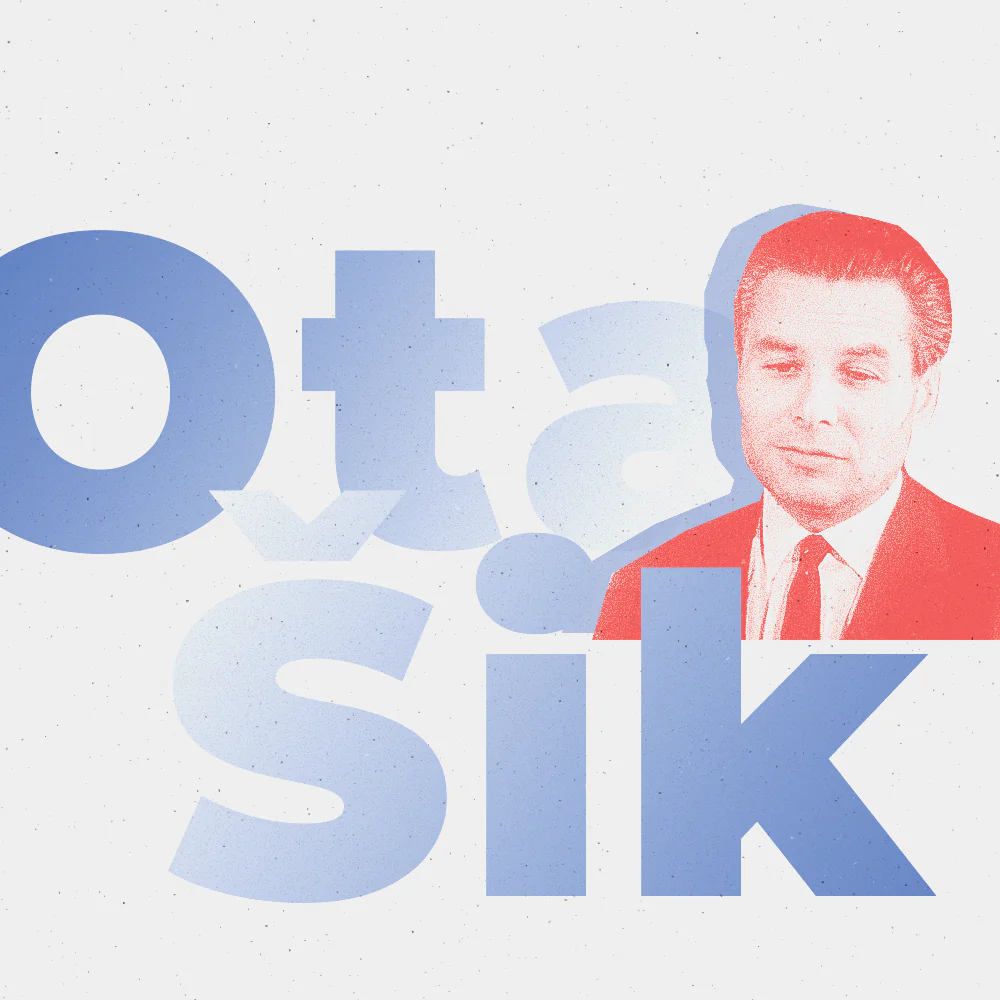
Ota Šik, the theorist behind the Czechoslovak reforms9/spichka: Ota Šik (1919–2004) was a Czechoslovak economist and politician.
After the Nazi occupation of Czechoslovakia in 1939, he joined the resistance and, in 1940, the Communist Party of Czechoslovakia (KSČ). In 1941, he was arrested by the Gestapo and sent to a concentration camp, where he was imprisoned alongside the future KSČ leader Antonín Novotný.
From 1961, he served as director of the Institute of Economics of the Czechoslovak Academy of Sciences and, from 1962, as a member of the Central Committee of the Communist Party. In 1968, he became deputy prime minister, after which his political career ended.
His book Plan and Market under Socialism was published in Czechoslovakia in 1968, and he became one of the key economic thinkers of the Prague Spring.
When Warsaw Pact troops entered Prague in 1968, Šik was on holiday in Yugoslavia. Fearing arrest, he emigrated to Switzerland, where he lived for the rest of his life, writing and teaching at the university.
Šik advocated a “third way”. He even published a book with that title: The Third Way: Marxist-Leninist Theory and Modern Industrial Society (1972). The first two paths were capitalism and Soviet socialism; the third was democratic market socialism., in his 1967 book Plan and Market Under Socialism10Šik, O. (1967). Plan and Market under Socialism. Prague: Academia. pointed out that abolishing private property does not eliminate differences in interests between individuals and social groups. The central goal of democratic planning, including the use of market mechanisms, is a form of development based on the coordination of these different interests. And it is perfectly clear that the formulation and representation of interests requires political freedom. Yet the transformations that unfolded in Czechoslovakia in 1968 were by no means reducible to the abolition of censorship and preparations for free elections.
The “Action Program” adopted by the Czechoslovak communists11/spichka: The Central Committee of the Communist Party of Czechoslovakia published the “Action Program” on April 5, 1968. On the night of August 20–21, Warsaw Pact troops entered Prague. After this, the “Action Program” was abandoned. provided for the creation of workplace self-management bodies. The mass participation of working people in economic decision-making, from below all the way up, not only laid the foundations for entirely new economic institutions but also shifted the focus in political life: from parliamentarism to industrial democracy, where a great number of problems could be resolved locally, without the involvement of political parties and officials, without the bourgeoisie and the bureaucracy.
Reforms in Czechoslovakia strengthened industrial democracy.
As is well known, the Prague Spring of 1968 was cut short by Soviet intervention. Far less well known is that the struggle over workplace self-management continued even after the Soviet invasion in August. Despite the occupation, enterprise councils were formed and began coordinating with one another. Only in 1969 did the new Czechoslovak authorities manage to dissolve the workers’ councils and return enterprises to state control. This process later became known as the “Second Prague Spring”.
From hope to neoliberalism
Meanwhile, the ideas of self-management proved popular not only in Czechoslovakia. Of course, when we speak of 1968 in Western Europe, student unrest in Paris is usually the first thing that comes to mind. In reality, it was not only a matter of youth revolt. Workers went on strike in France. In 1969, mass protests swept across Italy. In both cases, self-management slogans were raised and later developed in the theoretical and programmatic documents of left organizations and trade unions.
But why do we keep focusing on Europe? In that same year, 1968, General Juan Velasco Alvarado12/spichka: Juan Velasco Alvarado (1910–1977) was a left-wing Peruvian army general.
In 1968, Alvarado became the commander of the Peruvian army and chairman of the Joint Command of the Peruvian Armed Forces. That same year, he led a coup. His government called itself the Revolutionary Government of the Armed Forces.
Alvarado wanted to abolish the oligarchy’s power, eliminate all forms of exploitation, and build social democracy. The revolutionary junta — as they called themselves — nationalized enterprises in the main branches of industry.
The oligarchy sabotaged the government’s measures. In 1975, Velasco was overthrown and removed from office. He died two years later. came to power in Peru and proclaimed a program of wide-ranging social reforms. Ideas of self-managed socialism played a significant role there as well. Revolutionary sentiment spread rapidly across Latin America, and the victory of the Left in Chile’s 1970 elections was only the most visible part of this broader process13/spichka: In 1970, Salvador Allende won Chile’s presidential election. He received 36.6 percent of the vote, compared with 35.3 percent for his opponent, Jorge Alessandri. Chile’s electoral system at the time did not provide for a second round. If no candidate received an absolute majority, parliament voted on the leading candidates.
Allende had run for president before 1970. In 1952, he became a presidential candidate for the first time and received only 5.45 percent of the vote. That election was won by an independent candidate with 46.79 percent of the vote.
In 1958, Allende received 28.25 percent of the vote and came second. The liberal-conservative candidate received 31.56 percent.
In 1964, Allende received 38.6 percent, while his Christian Democratic opponent received 55.6 percent.
In other words, Allende’s result in 1970 was credible for a potential president of Chile, even if it was not the highest level of support he had ever received..
/spichka: Results of elections to the lower chamber of the Chilean parliament — the Chamber of Deputies
| Parties | 1969 | 1969 | 1973 | 1973 | Changes | Changes |
| Vote, % | Seats | Vote, % | Seats | Vote, % | Seats | |
| Confederation of Democracy | 53,81% | 89 | 54,18% | 87 | 0,37% | -2 |
| Christian Democratic | 31,05% | 56 | 29,07% | 50 | -1,98% | -6 |
| National | 20,82% | 33 | 21,51% | 34 | 0,69% | 1 |
| Other | 1,94% | 0 | 3,60% | 3 | 1,66% | 3 |
| Popular Unity | 42,95% | 61 | 43,28% | 63 | 0,33% | 2 |
| Socialist | 12,76% | 15 | 18,70% | 28 | 5,94% | 13 |
| Communist | 16,60% | 22 | 16,36% | 25 | -0,24% | 3 |
| Radical | 13,59% | 24 | 3,69% | 5 | -9,90% | -19 |
| Other | 0,00% | 0 | 4,53% | 5 | 4,53% | 5 |
| Independent parties | 3,24% | 0 | 2,54% | 0 | -0,70% | 0 |
| Total | 100,00% | 150 | 100,00% | 150 | 0,00% | 0 |
/spichka: Results of elections to the upper chamber of the Chilean parliament — the Senate
| Parties | 1969 | 1969 | 1973 | 1973 | Changes | Changes |
| Vote, % | Seats | Vote, % | Seats | Vote, % | Seats | |
| Confederation of Democracy | 50,31% | 27 | 57,25% | 30 | 6,94% | 3 |
| Christian Democratic | 34,32% | 22 | 33,88% | 19 | -0,44% | -3 |
| National | 15,99% | 5 | 18,97% | 8 | 2,98% | 3 |
| Other | 0,00% | 0 | 4,40% | 3 | 4,40% | 3 |
| Popular Unity | 47,26% | 20 | 42,75% | 19 | -4,51 | -1 |
| Socialist | 11,99% | 4 | 17,84% | 7 | 5,85% | 3 |
| Communist | 18,04% | 6 | 17,29% | 9 | -0,75% | 3 |
| Radical | 17,23% | 9 | 5,77% | 2 | -11,46% | -7 |
| Other | 0,00% | 1 | 1,85% | 1 | 1,85% | 0 |
| Independent parties | 2,43% | 3 | 0,00% | 0 | -2,43% | -2 |
| Total | 100,00% | 50 | 100,00% | 50 | 0,00% | 0 |
The Left in Chile got a chance to build democratic socialism.
Salvador Allende’s election as president of Chile opened the way, under very different conditions, for another attempt to realize the strategy of transformation that had taken shape during the Prague Spring and the European protests of 1968–1969. By nationalizing some enterprises, the left-wing government, on the one hand, encouraged the development of industrial democracy within them and, on the other, sought to use the achievements of cybernetics to create new mechanisms for communication and planning.
“Cybersyn” — the Chilean counterpart to Soviet OGAS — was thirty years ahead of its time.
The Chilean system “Cybersyn”, which Mark Fisher rightly called the “socialist internet”, really was three decades ahead of the management technologies that would only become familiar to us later. Here, incidentally, one might also recall the Soviet academician Viktor Glushkov, who tried to use cybernetics to modernize and optimize planning14/spichka: In the article “Viktor Glushkov’s information barriers”, we described Glushkov’s concept and offered a critique of it..
For the OGAS system15/spichka: OGAS stands for the National Automated System for Computation and Information Processing. proposed by Glushkov, the Soviet Union lacked the required computing power. In addition, each ministry promoted its own version of OGAS to secure a central role in the new administrative system. As a result, the project was implemented sector by sector, with the expectation that these parts would eventually be integrated into a single structure16/spichka: Alexey Safronov describes the initial rollout of OGAS in the USSR. Initially, OGAS was not presented as an antipode to the Kosygin reforms — that opposition was constructed only retrospectively.
There were two key problems.
First, the USSR did not produce enough computers to create OGAS.
Second, every ministry wanted to secure a central role in the creation of OGAS to gain greater influence in the future.
For more, see Alexey Safronov’s lecture “A Step into Cybercommunism: Computers and Planning in the USSR”, or his book Bol’shaya sovetskaya ekonomika [The Great Soviet Economy].. That future, however, never arrived.
There was even a joke that Glushkov wanted to replace the Politburo with robots: the political consequences of the academician’s proposals were, at the very least, unclear to the party leadership and therefore seemed suspicious — better not to rush.
It has become common to assume, retroactively, that the “market” reforms proposed in the 1960s in the USSR and Eastern Europe, and Glushkov’s ideas, represented two opposing scenarios for transformation. Credit should be given to Alexey Safronov, who has convincingly shown that this was not the case17/spichka: For more, see Alexey Safronov’s lecture “A Step into Cybercommunism: Computers and Planning in the USSR”. Alexey Safronov also writes about this in Bol’shaya sovetskaya ekonomika [The Great Soviet Economy].. The two approaches complemented one another and, at first, were promoted by the same people.
The same people initially promoted the Kosygin reforms and the creation of OGAS.
What is crucial here is that the so-called “market reforms” had nothing in common with the “free market” concepts promoted by neoliberal ideologists. The point was not to let market relations dominate people and enterprises, but to use them to solve the immediate tasks of optimizing economic activity, which may have entirely different priorities.
The Chilean revolutionaries, for their part, were well aware of the Czechoslovak experience. In the early 1960s, Valtr Komárek18/spichka: Valtr Komárek (1930–2013) was a Czech economist and politician.
He received his higher education in Moscow, worked in the State Planning Commission, and later in the economic section of the Politburo of the Central Committee of the Communist Party of Czechoslovakia. From 1964 to 1967, he worked in Cuba as a consultant to Che Guevara. In 1968, he supported the reforms.
In 1971, Komárek was removed from high office. Until 1989, he worked in academic research as an economist.
In December 1989, he became deputy prime minister of Czechoslovakia for the Social Democratic Party. In 1990, he was elected to parliament. In 2011, he became honorary chairman of the Social Democratic Party., a close associate of Ota Šik, worked in Cuba. Latin American leftists not only knew about the ideas being discussed in France and Italy; they also received a historic chance to put that agenda into practice.
Allende managed to carry out radical transformations while adhering to democratic norms and procedures.
The three turbulent years of the Chilean revolution were marked not only by successes. What matters, however, is that Allende’s government, first, managed to carry out radical social and economic transformations while strictly observing democratic norms and procedures, and, second, that support for the Left, despite difficulties and mistakes, grew over those three years. Following the electoral success of Allende’s supporters in regional elections, it became clear that the old ruling classes had no way back to power except through unconstitutional violence19/spichka: In Chile, the president was elected for a six-year term, while parliament was elected every four years. In the 1973 parliamentary elections, the Popular Unity coalition, which supported Allende, won 63 of the 150 seats in the lower chamber, the Chamber of Deputies, and 19 of the 50 seats in the upper chamber, the Senate.
For comparison, in the previous elections, held in 1969, Popular Unity had held 61 seats in the lower chamber and 19 in the upper chamber.
There were notable changes in how voters supported the parties within Popular Unity. The two radical parties — the Socialists and the Communists — gained seats: the Socialists gained 13, and the Communists gained 3. The more moderate Radical Party, by contrast, lost 17 seats.
It is therefore incorrect to speak of Popular Unity’s failure in 1973. The strengthened position of the Socialists and Communists likely prompted Pinochet and the other conspirators to forgo waiting for the 1976 presidential election and carry out a military coup instead..
In 1973, the coalition had two more deputies than in 1969, while its number of senators remained unchanged. Yet the balance of forces within the coalition shifted: the Socialists gained 13 seats, the Communists gained 3, while the center-left Radical Party lost 17 seats. Another 3 deputies from smaller parties also joined the coalition. Thus, support for the coalition as a whole remained roughly the same, while its most radical parties grew stronger.
General Pinochet’s coup in Chile in the autumn of 1973 not only brought an end to the project of democratic socialism in that country, drowning the revolution in blood, but also became a model for later coups in Uruguay and Argentina20/spichka: In 2006, when Pinochet died, Russian political commentators were debating whether Russia needed its own Pinochet.. The military did not merely launch campaigns of repression against the Left; they also began implementing their own economic agenda.
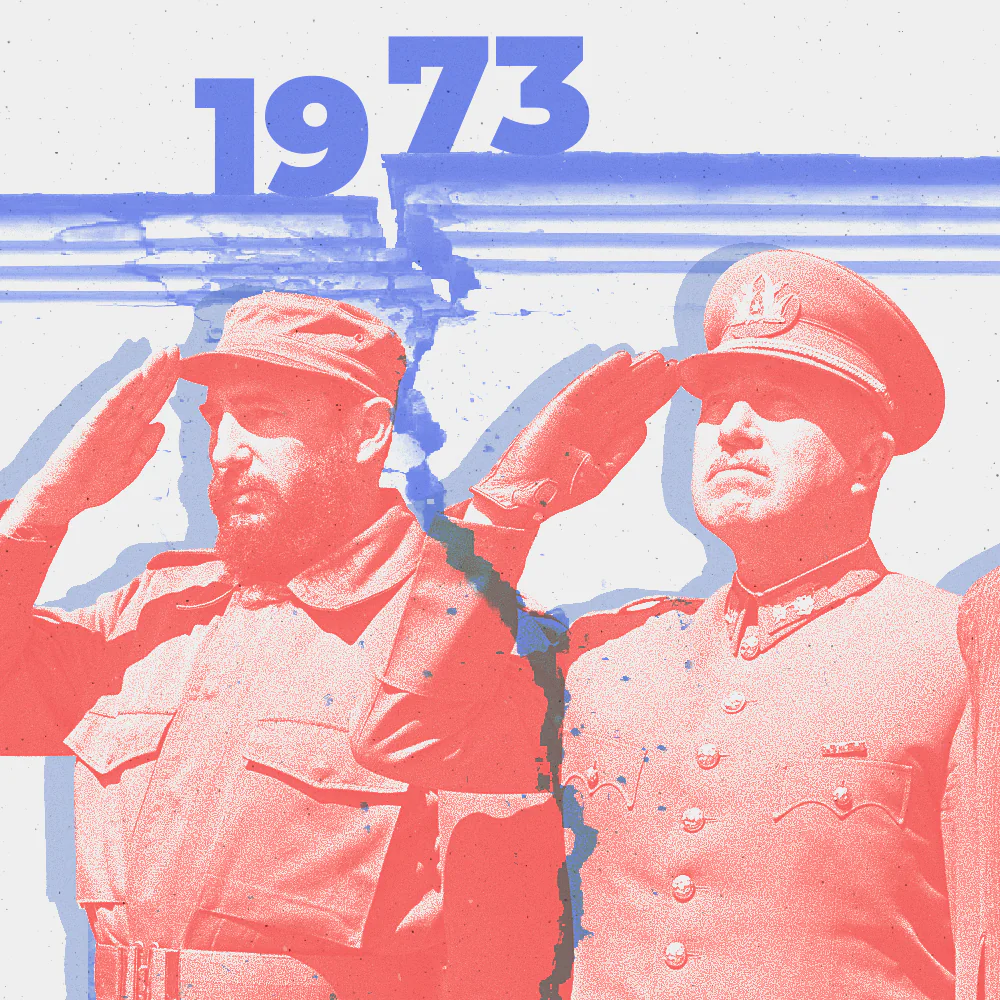
Pinochet became a role model for other generals in Latin America.
This agenda, which came to be known as neoliberalism, was initially implemented by dictatorial regimes in South America and was later adopted in Western Europe and the countries of the former Soviet bloc. This sequence was hardly accidental. The success of neoliberal reforms became possible through the suppression of workers’ resistance and, beyond that, of democratic institutions as such. This is why the implementation of neoliberalism in Western and Eastern Europe was much slower and far less consistent.
Capital was able to implement neoliberal reforms only by suppressing resistance and democratic institutions.
The erosion of democracy took place wherever this agenda was introduced, and we can now see its consequences, varying in scale, in countries from Russia to the United States. The dismantling of the welfare state, privatization, tax cuts for the rich, and the redistribution of resources in favor of the largest corporations and finance capital laid the groundwork for a sequence of crises, the largest of which was the Great Recession of 2008–2010, whose consequences have yet to be overcome. But this instability in economic and social life is, in a sense, the price capital is forced to pay for its decisive victory over the alternative projects of social development that emerged from the experience of the 1960s and 1970s.
Neoliberal reforms caused a sequence of crises, the largest of which was the Great Recession of 2008–2010.
Piecemeal reforms instead of social transformation
What is crucial, however, is that the defeat of the Chilean revolution marked the beginning of a new stage in the development of capitalism and produced radical changes within the Left. These changes, of course, did not come immediately, but it is noteworthy that after the coup in Chile, the Italian communists, who represented perhaps the most mass-based and theoretically advanced left party in Europe, began to rethink their strategy.
Italian communists were the first to abandon the radical agenda in favor of piecemeal reforms.
The general secretary of the Italian Communist Party at the time, Enrico Berlinguer21/spichka: Enrico Berlinguer (1922–1984) was an Italian politician. From 1972 to 1984, he served as General Secretary of the Italian Communist Party (PCI).
After Pinochet’s coup in Chile, Berlinguer published a series of articles in the PCI’s theoretical journal in 1973. There, he argued for a historic compromise with Catholics and the progressive bourgeoisie to prevent a far-right coup in Italy.
Berlinguer became one of the first theorists of Eurocommunism. In 1977, the Communist parties of Italy, Spain, and France openly adopted these positions. explicitly argued for a change in the politics of the Left in line with the lessons of Chile. What this meant was a retreat from attempts to transform society as a whole, according to a coherent political conception, following the example of the Prague Spring or the Popular Unity government in Chile in 1970–1973. Berlinguer saw the alternative as a policy of gradual advance through piecemeal reforms that would change the balance of forces in society, within the framework of a “historic compromise” with the progressive part of the bourgeoisie.
Piecemeal reforms seemed far more realistic to the Left than the transformation of society.
This approach seemed far more realistic than the ideas of a revolution based on self-management that had emerged in the late 1960s. Unfortunately, it encountered a serious obstacle: the “progressive” fraction of the bourgeoisie itself was becoming increasingly marginal with each passing year. Given this tendency, which we can still observe today, progressive members of the bourgeoisie will soon have to be added to the Red List and preserved alongside other endangered species.
The Left did not become moderate reformists overnight.
Of course, the turn towards reformism and moderation did not happen everywhere at once, nor did it unfold evenly. In the same way, the retreat of the Left and the loss of its political influence did not immediately become an obvious trend. In Portugal, the Carnation Revolution took place in 1974, led by progressive officers: the “April captains” dreamed not only of establishing democracy in the country, but also of carrying out the radical transformations that were then part of the Left’s agenda22/spichka: The Carnation Revolution took place in Portugal on April 25, 1974. It was a military coup organized by the left-wing Captains’ Movement, made up of army officers. Since they carried out the coup in April, they became known as the “April captains”. The “captains” overthrew the dictatorship of António de Salazar and established a transitional government. In 1976, the military organized elections. Power passed to political parties, and Portugal became a democratic regime. At the same time, the Constitution enshrined the country’s course towards the construction of socialism.. Portugal became a democracy, but socioeconomic changes were held back, and one of the main obstacles to realizing these changes was the Socialist Party, which had already taken the path of moderation23/spichka: The Socialist Party of Portugal is one of the country’s most popular parties. It was founded in 1973 and received 35 percent of the vote in the 1976 elections. By the 1980s, it had become a moderate center-left party..
Military progressivism was also defeated in Peru. The reforms initiated by General Velasco Alvarado proved half-hearted, and Velasco himself was removed from power by his own associates24/spichka: Juan Velasco Alvarado (1910–1977) was a left-wing Peruvian army general.
In 1968, Alvarado became the commander of the Peruvian army and chairman of the Joint Command of the Peruvian Armed Forces. That same year, he led a coup. His government called itself the Revolutionary Government of the Armed Forces.
Alvarado wanted to abolish the oligarchy’s power, eliminate all forms of exploitation, and build social democracy. The revolutionary junta — as they called themselves — nationalized enterprises in the main branches of industry.
The oligarchy sabotaged the government’s measures. In 1975, Velasco was overthrown and removed from office. He died two years later.. Later, calls for self-managed socialism were taken up again, in France at the beginning of Mitterrand’s presidency and in Poland’s Solidarity movement. But such projects either never got off the ground or were quickly abandoned. Even where the ideology remained radical, as in the Brazilian Workers’ Party, political practice increasingly diverged from it25/spichka: The Workers’ Party was founded in the 1980s as a coalition of left-wing movements opposing the military dictatorship. One of the party’s founders was the trade union leader Lula da Silva.
Lula was president of Brazil from 2003 to 2011 and has held the office again since 2023.
Despite its radical rhetoric, the Workers’ Party and Lula da Silva did not transform Brazil’s economic system, limiting themselves to reforms.
For more, see our article “The Left in Latin America”..
After 1975, a growing number of left parties became moderate reformists.
Nevertheless, in the second half of the 1970s and the early 1980s, the general trend towards “moderation” began to prevail over the radicalism of the previous decade. After the Italian communists, this path was taken by the socialists of France and Spain, by the British Labour Party, which, to be fair, had never been especially revolutionary even in its best years, and then by the left parties of Latin America.
The defeat of the Left in Chile became a justification for the moderate agenda.
A standard argument for the new moderation was that “the Chilean project failed”. In Eastern Europe and the former USSR, the defeat of the Prague Spring was invoked as a reason to abandon democratic socialist ideas. Yet, as Mark Fisher rightly notes, there was no “failure”. If a project is interrupted by violence, that does not mean it was being implemented incorrectly. If anything, the opposite is true. If violence had to be used to stop the experiment, then it is at least reasonable to assume that, without it, the experiment might have had a chance to succeed26/spichka: The full quotation:
“The horrific testing ground for that is, first of all, Chile — a democratic socialist project, close to the US, very different from anything to do with the Soviet bloc, technologised, had the so-called socialist internet, CyberSyn, in place, destroyed… It can’t be said, “ah, it didn’t work, what happened in Chile”. It didn’t work because there was a CIA-backed coup to destroy it — the military destruction of the Allende government in Chile — which I think then provides a kind of prototype for what would happen afterward. In places like the UK, it wasn’t quite so immediately violent. There was violence — the Miners’ Strike, etc. — but it was a kind of capitalist-realist lab which allowed capital to experiment with these new forms of subjection”.
Source: Fisher, M. (2021). Postcapitalist Desire: The Final Lectures. Repeater Books, p. 51..
If it took a military coup to derail Chile’s societal transformation, then the Left had a chance of success.
Of course, the political or military defeat of a social project is still a defeat, and its lessons must be taken into account. But it nevertheless gives us grounds to think about the internal logic of the unfinished experiment itself, and about what might have happened had it not been violently interrupted.
A premature revolution?
The founders of socialist theory assumed that a new type of society would arise on the basis of a higher development of the productive forces, once they had “outgrown” the limits of capitalist relations of production. And if the flourishing of capitalism was clearly tied to the rise of industry and large-scale machine production, then postcapitalist society, to use Fisher’s term, or socialist society, would have to be based on the new postindustrial technologies that are entering our lives right now. This leads Fisher to the conclusion that the material conditions for transition in the 21st century are even more favorable than they were in 1968–1973. Unlike in that earlier period, however, the political, psychological, and moral conditions have worsened.

Socialism can only be built on the basis of the postindustrial technologies that are entering our lives.
Can we conclude that the attempts of 1968–1973, like the revolutions of the first half of the 20th century, were “premature” in historical terms, and that the successes of Bolshevism, Maoism, and Castroism were not connected with the realization of a socialist agenda as such, but with a modernization agenda? A similar conclusion emerges when reading Alexander Shubin’s books The World Revolutionary Wave, 1918–1923: The Rising Tide27Shubin, A. V. (2020). Mirovaya revolyutsionnaya volna (1918–1923): Priliv [The World Revolutionary Wave (1918–1923): The Tide]. Moscow: Akademicheskiy Proekt. and The Ebb28Shubin, A. V. (2025). Mirovaya revolyutsionnaya volna (1918–1923): Otliv [The World Revolutionary Wave (1918–1923): The Ebb]. Moscow: Akademicheskiy Proekt., devoted to the revolutionary wave of the early 20th century.
None other than Karl Marx wrote:
“No social order is ever destroyed before all the productive forces for which it is sufficient have been developed, and new superior relations of production never replace older ones before the material conditions for their existence have matured within the framework of the old society”29Marx, K. (1977). A Contribution to the Critique of Political Economy. Moscow: Progress Publishers, p. 21..
Does this logic lead us to conclude that the defeats of the 20th century were historically inevitable, and to add that the classics of Marxism themselves were too hasty in promising an imminent transition to socialism at a time when the industrial revolution was still far from exhausting its potential?
If the communists’ defeats in the 20th century were inevitable, does that mean the classics were too hasty in promising imminent socialism?
One might think such conclusions follow naturally. Yet this raises questions. After all, capitalism began to take shape before the Industrial Revolution occurred. Bourgeois relations of production already existed in Flanders, Northern Italy, and Bohemia in the 14th century and later entered England and France long before the steam engine was invented. Manufactories, banks, trading houses, stock exchanges, wage labor, and joint-stock capital had already developed in the preindustrial era and, in turn, helped bring the Industrial Revolution closer.
It is hard to deny that England’s political revolution, and the Dutch revolution before it30/spichka: The Dutch bourgeois revolution unfolded in two stages: 1566–1609 and 1621–1648. The English bourgeois revolution of 1639–1651 destroyed feudal relations and created the conditions for the development of capitalism. helped create favorable conditions for the emergence of new productive forces. In other words, weren’t emerging bourgeois relations already creating a firmer economic basis for their own development?
History does not move in a straight line, and the success of its stages is nothing like a railway timetable with the train stops announced in advance.
History is not a train schedule. It is nonlinear.
Assessing the historical results of the Paris Commune, Jean Jaurès31/spichka: Jean Jaurès (1859–1914) was a French historian, politician, and leader of the Socialist Party in France.
From 1893 onward, he sought to unite various socialist parties against the existing order. Thanks to his public speaking skills, Jaurès became popular not only among workers but also among the bourgeoisie.
Between 1905 and 1914, Jaurès fought to prevent war in Europe. In April and May 1914, the socialists under his leadership won 102 seats in parliament. In June, the socialist fraction voted against war credits. In July, at an emergency party congress, Jaurès secured the adoption of a declaration calling for a general strike in the event of war; this was already after the assassination of Franz Ferdinand. Jaurès rejected the prime minister’s proposal to enter the government and strengthen national unity.
At the end of July, Jaurès was shot dead by a French nationalist. convincingly observed32/spichka: Unfortunately, the exact source of Jean Jaurès’s statement could not be found. Boris Kagarlitsky wrote the following about it:
“The statement I am reproducing from memory does not come from A Socialist History of the French Revolution. It appeared in one of his speeches, published, I believe, in an anthology of socialist texts in Russia before the First World War, or by some social-democratic publisher abroad. But I can absolutely vouch for the accuracy of my retelling, so please leave it as it is”. that it would be naive to think that, had the Commune succeeded, France would have become a socialist state by the beginning of the twentieth century. But a victory of the Communards would undoubtedly have accelerated social development. I would add: perhaps economic development as well.
Applying this logic to the history of 1968–1973, we are inevitably led to ask whether the new postindustrial technologies we speak of today might, had that revolutionary wave succeeded, have appeared earlier, in different places, under different circumstances, and in a somewhat different form. The creation of the Cybersyn network33/spichka: Cybersyn was a centralized planning system implemented in Chile. It connected five hundred enterprises through the Cybernet network. Information from enterprises was transmitted in real time to the control room in the La Moneda presidential palace in Santiago.
In 1973, after the military coup, Cybersyn’s control center was destroyed. in Chile under Allende is, in fact, already an answer to that question.
If the democratic socialists of the 1960s and 1970s had succeeded, the necessary technologies might have appeared earlier.
But even if we look at the history of the Internet in the United States, we immediately find that the future worldwide network did not emerge from market relations. It emerged as a state-social structure, formed precisely because it was independent of the logic of the market and private profit. It is clear that the political conditions of democratic socialism are especially favorable for technological projects of this kind, and this was just as true in the early 1970s as it is today.
Why do we still care about the 1960s?
While discussing the transformation of society, we cannot, of course, separate technology from politics. In the early 1920s, when Sukhanov and other social democrats reproached the Bolsheviks for launching a socialist revolution in a country that had “not attained the level that makes socialism possible”, Lenin emphasized the political circumstances that made a radical socialist agenda both necessary and historically justified34Lenin, V. I. (1973). “Our Revolution (Apropos of N. Sukhanov’s Notes)”. In Collected Works, Vol. 33. Moscow: Progress Publishers, p. 478.. But in a certain sense, the opposite may also be true: the defeat of democratic socialism in 1968–1973 slowed and distorted economic development — not only in particular countries but worldwide.
The cause of the Left’s defeat in the 1970s was not political mistakes but the balance of class forces.
The point, however, is that this defeat resulted not so much from political mistakes made by the Left as from the balance of social and mass forces; consequently, the Left’s mistakes were not tactical but stemmed from an insufficient understanding of this strategic balance. And in any case, should this really be described in terms of mistakes, or are we dealing with tragic contradictions inseparable from the historical process?
One way or another, the defeat of the Left in 1968–1973 changed more than the political landscape — it changed capitalism itself, giving room for the new tendencies to develop. The alternative to socialist transformation was not just neoliberalism, but, to use Naomi Klein’s term, “disaster capitalism”35/spichka: Naomi Klein (b. 1970) is a Canadian left-wing journalist and writer.
In 2007, Klein published The Shock Doctrine: The Rise of Disaster Capitalism. There, she reveals how disasters are used to push through neoliberal economic policies..
Schumpeter36/spichka: Joseph Schumpeter (1883–1950) was an Austrian and American economist and political scientist.
Although Schumpeter was a critic of Marxism, he believed that capitalism would lose to socialism because, in the course of its own successful development, capitalism becomes monopolized and socially unstable. There are two possible ways out: revolutionary transformation or constant concessions from entrepreneurs. Schumpeter wrote this in his 1943 book Capitalism, Socialism and Democracy.
In that book, Schumpeter popularized the term “creative destruction”. The idea is that innovative technologies, industries, and sectors destroy older, less efficient ones. Economic progress moves through this destruction of the old. had already written about capital’s tendency toward creative destruction. But in the new form of capitalism, destructive action becomes increasingly dominant, making it a key instrument of accumulation and a necessary condition for reproduction.
Only now can we assess the long-term consequences of the bourgeoisie’s neoliberal revenge.
The world’s growing instability is systemic, and the explanation for what is happening lies in political economy rather than in politics. Many books and articles have already described the neoliberal model of capitalism that triumphed at the end of the 20th century as the social revenge of the bourgeoisie, rolling back nearly a century of concessions won by workers. But only now can we fully assess the long-term, systemic consequences of that revenge.
Regulated capitalism of the 20th century minimized the problems produced by cyclical market crises, but only at the cost of social concessions. From the late 1970s onward, however, the ruling classes came, partly spontaneously and partly consciously, to believe that the risks posed to them by social and economic reforms aimed at overcoming or avoiding crises were greater than the costs and problems produced by the crises themselves.
Not to eliminate the crisis, but to live with it — the bourgeoisie’s new approach.
In other words, if overcoming crisis tendencies would require the system to radically change and eventually abolish itself, then it is better not to resolve crises at all, but instead simply learn to live with them. As we can see, the result is that cyclical crises, which do not occur exclusively in the economy but in other spheres of life as well, become more frequent, overlap with one another, and turn into a single process: a general chronic crisis that reproduces itself.

At the same time, the enormous resources accumulated over the past two centuries allow the system to live, for an almost unlimited period, in a mode of constant reproduction and even intensification of crisis. The key word, however, is “almost”. Objective limits and boundaries do exist; we simply will not know them until we run up against them. And that moment may not be so far away.
Accumulated resources allow capitalism to live in a state of crisis almost endlessly. Almost.
The growing frequency and, above all, scale of armed conflicts, along with recurring social crises and uprisings of masses angered by them, show that the situation on the planet is slipping out of the ruling classes’ control. The problem is not a shortage of resources as such, but the way they are used and distributed, which produces an increasing number of conflicts. At the same time, neither armed conflicts themselves nor popular uprisings, nor even political coups, change the system: they are only symptoms of a progressive illness, caused by underlying processes.
Wars, coups, and riots do not change the system: they are only symptoms of the global system’s illness.
For society to enter a new qualitative state, political change alone is not enough. What is required is systemic reconstruction: changing social relations and the rules of the game, and creating a new balance of forces — something that repeated popular uprisings and middle-class revolts have not yet achieved. At times, quite radical slogans and demands do appear, including those that question property relations. But behind them, there is still no systemic or worldview depth comparable to that of the movements of 1968–1973.
Capitalism can, of course, hope to renew itself by introducing artificial intelligence, but technologies of this kind are more likely to sharpen the system’s contradictions than to compensate for them. Here, the contradiction between the productive forces and the relations of production appears in a whole range of ineffective measures taken by corporations and governments. They turn the technological revolution into an excuse for inflating yet another financial bubble, or clumsily try to address the consequences of their own efforts to digitize the economy.
Artificial intelligence is not a panacea for capitalism. It only sharpens its contradictions.
In the article “The Long Downturn and Its Political Results”37/spichka: The article “The Long Downturn and Its Political Results” was published in New Left Review in 2025., American Marxists Robert Brenner38/spichka: Robert Paul Brenner (b. 1943) is an American Marxist economic historian and professor of history at the University of California, Los Angeles. He is a member of the editorial board of New Left Review, a Marxist theoretical journal. and Dylan Riley39/spichka: Dylan John Riley (b. 1971) is an American Marxist historian and professor of sociology at the University of California, Los Angeles. He is a member of the editorial board of the Marxist theoretical journal New Left Review. point out that total factor productivity has been steadily declining in most developed capitalist countries since the mid-1970s. Many other authors, holding very different views, have reached the same conclusions.
One can say that a broad consensus has already formed among economic historians on this question. Many of them indicate 1973 as the starting point of the trend. Clearly, the problem is not the absence of new technologies, as we can see perfectly well that they continue to appear across many areas of life and branches of the economy. The problem lies in the system’s shrinking capacity to use them effectively for its own development and consolidation.
With the emergence of new technologies, capitalism’s contradictions only become sharper.
With each new cycle of technological progress, contradictions sharpen, and disproportions accumulate. At first glance, this appears to be a classic example of the contradiction between the productive forces and the relations of production described by Marx. But the social side of the process must also be considered: social structures disorganize, bonds break down, and relations become unstable.
Society is becoming disorganized, bonds are breaking down.
Where political economy identifies the overaccumulation of capital — capital that it is more profitable to squander than to invest in income-generating production that lowers the general rate of profit — the anthropologist or sociologist finds the proliferation of “bullshit jobs”40Boris Kagarlitsky’s note: from the standpoint of the capital overaccumulation theory, the rise of “bullshit jobs” reflects the contradiction between the effort to hold down wage growth and the need to sustain demand., described by David Graeber41/spichka: David Graeber (1961–2020) was an American anthropologist. Politically, he was an anarchist and took part in social movements, including Occupy Wall Street.. Where populist politicians argue about uncontrolled migration, an economist sees an inefficient distribution of resources, both between countries and within them. One can, of course, call all this “liquid modernity”, but behind these symptoms lies a creeping process of desocialization and growing chaos in social relations.
The disorganization of society is a problem for the Left. It also explains the crisis of democracy.
The disorganization of society in the age of late capitalism is becoming a political problem for the Left and, to a large extent, helps explain both the successes of the far right and the growing crisis of democracy, now under pressure from above as well as from below. The instability of social life prevents people from recognizing and clearly formulating their interests and then defending them in an organized way.
“Identity politics” failed because identities dissolve faster than class ties.
In the 1990s and 2000s, liberal leftists tried to replace weakening class ties and the forms of political organization built around them with “identity politics”. But the paradox explaining their universal failure is that, as desocialization advances, identities are dissolved even faster and more thoroughly than class structures, which have certainly been weakened, but they continue to be reproduced by the logic of bourgeois relations of production.
Politics is impossible without a subject, but creating one under conditions of atomization is difficult.
Mark Fisher42/spichka: Mark Fisher (1968–2017) was a British left-wing culturologist. He received his PhD in 1999. Fisher became widely known after the publication of Capitalist Realism: Is There No Alternative? (2009). By “capitalist realism”, he meant the belief that capitalism is the only viable system and that there is no alternative to it. In 2017, Fisher died by suicide after many years of struggling with depression. wrote in Capitalist Realism: “The required subject — a collective subject — does not exist, yet the crisis, like all the other global crises we’re now facing, demands that it be constructed”43Fisher, M. (2009). Capitalist Realism: Is There No Alternative? Winchester: Zero Books, p. 72.. Subjectless politics is impossible — or, more precisely, it makes for very bad politics, reflecting nothing more than a sum of accidental conjunctures and manipulations. But constructing a collective subject “from scratch” under conditions of increasing desocialization and social atomization is not an easy task.
The need for change is greater today than it was in the 1960s and 1970s.
A paradoxical conclusion suggests itself. If we compare the present situation with the period of 1968–1973, it turns out that the conditions for a transition to a new society may have been less “mature” from a technological standpoint, but largely they were more favorable socially, politically, and culturally. At the same time, the need for change imposed by the current situation has now reached an extreme level of severity, unlike anything seen either in the “prosperous 1960s” or in the “stable 1970s”.
If the situation has changed so radically, then it is reasonable to ask the same question Mark Fisher asks himself and his listeners: “Why do we still care about the 1960s?” In his view, it has to do with “unrealized desires” inherent in certain cultural forms44Fisher, M. (2021). Postcapitalist Desire: The Final Lectures. Repeater Books, p. 101.. Forms change, but desires and needs remain. More than that, the sharpening contradictions force us to return to the unrealized radical agenda again.
The sharpening contradictions of capitalism force us to return to the radical agenda.
Neoliberal capitalism and left-wing politics
Can desire be subjectless? Of course, we all experience different feelings, and we develop various needs — formally, each person has their own, but in fact, many of them are the same. These shared social needs are precisely what form the objective foundation of group and class identity. But this commonality still has to be recognized and articulated.
The ruling circles are ready to stimulate the emergence of any identities except for class-based ones.
Fisher points out that, on the one hand, the development of the economy and society constantly creates conditions, or at least preconditions, for postcapitalist practices. On the other hand, neoliberalism must constantly suppress and restrain them in order to preserve the system. Under these circumstances, the ruling circles are ready to stimulate the emergence and rivalry of any identities except for class-based ones.
Engineers, scientists, and IT specialists are not ready for collective action, but they resist the loss of their privileges.
Meanwhile, despite all obstacles, we are witnessing the spontaneous formation of a new social community that could be called the postindustrial or late proletariat, if one prefers, even the post-proletariat: a mass of new wage workers who are more likely to resist proletarianization than to develop class consciousness in the forms inherited from the 19th and 20th centuries45Boris Kagarlitsky’s note: The concept of “proletarianization”, as well as the analysis of resistance to this process among scientific and intellectual workers, can be found in Western sociological literature. Immanuel Wallerstein, in particular, wrote about proletarianization as an uneven process. In Soviet studies of the 18th and 19th centuries, the concept of the “semi-proletariat” was also frequently used.. This is precisely why the traditional left agenda, along with its vocabulary, turns out to be both extremely relevant and visibly outdated, even archaic.
Scientists, engineers, and computer specialists, of course, do not like feeling like cogs in the corporate machine. Forms of collective action that were organic and natural for industrial workers in large enterprises are difficult for them to maintain. They are hired through individual contracts that create the illusion of an equal “partnership” with the corporation, and they are not ready to fight for the collective or sectoral agreements defended by trade unions. Despite all their opportunities and privileges, they are becoming increasingly dependent on the labor market, just like others who have either already resigned themselves to their fate or, conversely, come to recognize themselves as a party to the class struggle.
We can feel nostalgic for the good old days of industrial capitalism, but we have what we have. The transition has already begun, but it is unfolding under less favorable conditions than those expected in the 1960s and 1970s, and within the capitalist system. Whether we like it or not, this is what we have to work with. More importantly, it is something we can work with.
Industrial capitalism belongs to the past — society is changing. But there is still room to work under the new conditions.
Fisher is right to point to the nascent growth of class consciousness, which still finds no adequate expression in either politics or culture. As an alternative, he calls to “regain the optimism of that Seventies moment, just as we must carefully analyse all the machineries that capital deployed to convert confidence into dejection”46Fisher, M. (2021). Postcapitalist Desire: The Final Lectures. Repeater Books, p. 16..
Is bourgeois hegemony the only problem? “The story of how the counterculture was co-opted by the neoliberal Right is now a familiar one, but the other side of this narrative is the Left’s incapacity to transform itself in the face of the new forms of desire to which the counterculture gave voice”47Fisher, M. (2021). Postcapitalist Desire: The Final Lectures. Repeater Books, p. 20..
The Left lost its political potential and became moralists, canceling one another over “wrong” words.
The political rise of 1968–1973 gave a major boost to cultural change, in the broadest sense of the term: from cinema and music to lifestyle, forms of education, and patterns of behavior. Unfortunately, the political potential was lost. The revolution in lifestyle culture absorbed the political revolution, depriving the left movement of what mattered most — the will to power.
Despite the obligatory admiration for the dynamic and turbulent years of the recent past, leftists became nerds and moralists, ready to endlessly argue over the “wrong” language or over assessments of the events they cannot and do not want to influence, while proving incapable of fighting for practical change by drawing people who are not burdened with an articulated political ideology.
The permanent crisis, created by neoliberalism, is the ideal environment for the far right.
The radical right intuitively grasped the spirit of the age and offered its own version of populism. As Fisher observed, they “play class politics in order to suppress class consciousness”48Fisher, M. (2021). Postcapitalist Desire: The Final Lectures. Repeater Books, p. 163., using the fears, frustration, and social and cultural disorientation produced by the system. In this sense, the permanent crisis reproduced by neoliberalism becomes their ideal habitat. Uneducated sections of the masses can be set against the educated: “native” residents of a country or city against “newcomers”, one people against another. The misfortune is that the Left also constantly and eagerly joins this game, turning itself into the politically correct mirror image of the Right.
The task of the Left’s class politics is to seek common ground, to unite rather than divide.
But where did we get the idea that populist politics must inevitably be tied to a reactionary or conservative agenda? The new society is far more fragmented than the society of the second half of the 20th century. Yet this is precisely the task of modern class politics: to find common ground and reasons for commonality, while offering a comprehensive agenda.
The aesthetic of diversity produced by the counterculture of the late 1960s can work for unity as well as division, provided that, within this diversity, we look for the invariants of a fundamental commonality: the very same “postcapitalist desire”, the need to break beyond the limits of the system.
Left-wing politics will be built on a coalition rather than monolithic unity.
The left-wing politics that still has to be worked out in practice will undoubtedly be built not on monolithic unity but on coalition-based solidarity, with class consciousness becoming a result of joint political action rather than its precondition.
Coalition is an organizational form, and it does not work without a corresponding agenda.
To a certain extent, left populism and broad coalitions, typical of Latin America in the 20th century, do not appear to have been specific to that region or period but rather to be a prototype for new forms of left-wing political organization. Let us not forget: an organizational form does not work without a corresponding agenda.
If we cannot agree on a comprehensive program that reflects the desires and needs of different social and cultural groups, no coalition agreement will help. And if that comprehensive program proves superficial and fails to address issues that can only be resolved through systemic change, then even electoral success and the popularity of brilliant, charismatic leaders will not help — as we have recently seen in Peru49/spichka: In Peru, Pedro Castillo was elected president in 2021, with Dina Boluarte as his vice president. Both represented the socialist party Free Peru. In 2022, Congress impeached Castillo on charges of rebellion and abuse of power.
Boluarte then became the president. In 2025, Congress impeached her.
The next president was José Jerí, a representative of the center-right party, the Alliance for Progress, but in February 2026, Congress impeached him on suspicion of corruption. José María Balcázar then became the president — once again as a candidate of Free Peru. and Chile, where the Left failed after coming to power following brilliant electoral campaigns50/spichka: In Chile, Gabriel Boric became the president in 2021 as the candidate of the left coalition Approve Dignity. Before the election, he promised to do away with neoliberal policies and reform Chile. In 2022, he proposed a constitutional reform, but it was never carried out.
In 2025, José Antonio Kast of the right-conservative Republican Party became the president..
The missed historical chance of 1968–1973 must serve as a lesson.
The conditions that existed in 1968–1973, which gave rise to a mass revolutionary movement, were far less technologically mature for a transition to a new society than the conditions we have today, but in many ways they were more favorable. Since then, economic and social relations have become increasingly chaotic, left-wing politics has undergone a catastrophic crisis, and state institutions in democratic countries have experienced unprecedented corruption-driven decay. Society’s influence over political decisions has weakened, while the “revolt of the elites”, which was convincingly described by Christopher Lasch51/spichka: Christopher Lasch (1932–1994) was an American historian.
In The Revolt of the Elites and the Betrayal of Democracy, Lasch shows how the gap between the upper and lower classes in the United States was widening. He reveals how the elites became detached from the masses not only in income, but in place of residence and leisure. They created a voluntary ghetto for themselves, with private schools and private security, and got out of ordinary life altogether., has pushed the representation of the people back almost to the level of the 19th century, when ordinary citizens’ opinions mattered only when they matched those of the ruling class.
And yet the need for change exists objectively and is felt everywhere. It is exactly the institutional crisis produced by neoliberalism that gives millions of people, if not a clear understanding, then at least a sense that the current situation is abnormal and must be radically changed.
The crisis of institutions makes people realize that the system has to be changed.
Unfortunately, the direction of these changes remains a mystery to people, creating fertile ground for the flourishing of all kinds of reactionary utopias. In this respect, we catastrophically lag behind the great five-year period of 1968–1973, when the direction of change was, or at least appeared to be, more or less clear almost everywhere.
What kind of change is needed? This remains a mystery to people.
It is this new clarity and the new prospect that we have to create. To do so, among other things, we can also draw on the experience of 1968–1973: on the left and revolutionary movements of that period, and on the culture and tradition shaped by them.
The past cannot be repeated. There is no going back.
But we can start again.
Postscript by /spichka
Through hardship: how this article reached us
As soon as Boris Kagarlitsky finished the article “Socialism: A prospect, not a utopia”, he proposed returning to the question of socialism, but this time with an emphasis on the 1960s and 1970s:
“While writing this, I came up with the idea for a new article devoted to the missed chance of 1968–1973 (Czechoslovakia, Chile, France, and so on). If this is of interest to Spichka, let me know and send 4–5 blank forms” (15 December 2025).
Of course, we were interested. We sent the letter (blank) forms and began receiving the text in batches.
Unfortunately, the original conclusion to the article you have just read was lost somewhere in the prison bureaucracy, and only part of the second version made it through.
“The final part of my article on the missed chance was probably lost because I was transferred from the hospital52/spichka: In late November 2025, Boris Kagarlitsky was sent to the hospital in Tver after complaints about his eyesight and blood pressure. He remained there for treatment until 26 December, after which he was returned to the penal colony. back to PC-4 [Penal Colony No. 4]. I will have to write it from scratch” (11 February 2026).
“It is good that most of the text arrived, although the missing pages are upsetting. <…> Please provide the full text of the conclusion as you have it, so I can see exactly what is missing and finally finish this ill-fated article” (22 March 2026).
Eventually, we put all the pieces of the text together.
Could it have been different?
At times, we speculate: could the communists, at one point or another, have succeeded in building a “worldwide” socialist republic? Usually, we end this discussion by concluding that the conditions for socialism had not yet matured: the technology was not there, the people were wrong, and the level of education was too low.
Yet in doing so, we forget that a people that has taken power into its own hands can release its full potential, accelerating both social and economic development.
“It does not occur to any of them to ask: but what about a people that found itself in a revolutionary situation such as that created during the first imperialist war? Might it not, influenced by the hopelessness of its situation, fling itself into a struggle that would offer it at least some chance of securing conditions for the further development of civilisation that were somewhat unusual?”53Lenin, V. I. (1973). “Our Revolution (Apropos of N. Sukhanov’s Notes)”. In Collected Works, Vol. 33. Moscow: Progress Publishers, p. 478.
Would such a people run up against obstacles, against bureaucracy? Would it necessarily win?
No — no one can guarantee success, but that does not mean the struggle is futile.
And we have the example of the entire socialist bloc, where, despite enormous progress, the bureaucracy proved stronger.
Why the October Revolution reached its endpoint in 1991 has long been debated. But could communists have changed society in the late 1960s and early 1970s? Could they have built that very democracy for the majority, rather than for a handful of oppressors?
In his new article, Kagarlitsky concludes that the main problem in the 1970s lay in the balance of class forces. People were not yet ready. Today, however, the crisis of neoliberal capitalism is obvious, and the need for change is growing stronger.
Marxists must draw conclusions from the successes and defeats of the 20th century.
As Boris Kagarlitsky wrote in Marxism: An Introduction to Social and Political Theory:
“The experience of the 20th century, including the unfortunate experiment of President Allende in Chile, shows that anti-systemic leftists should hardly be guided by the optimism of late Marx. <…> Where parliamentary democracy begins to serve the cause of social transformation, the ruling class rapidly loses any sympathy for it”54Kagarlitsky, B. Y. (2021). Marksizm: vvedenie v sotsial’nuyu i politicheskuyu teoriyu [Marxism: An Introduction to Social and Political Theory] (3rd ed.). Moscow: LENAND, p. 261..
“Modern capitalism leaves little room for reformism. This means that everything classical Marxism teaches us becomes relevant again”55Kagarlitsky, B. Y. (2021). Marksizm: vvedenie v sotsial’nuyu i politicheskuyu teoriyu [Marxism: An Introduction to Social and Political Theory] (3rd ed.). Moscow: LENAND, p. 267..
What alternative to capitalism will Marxists put forward? Let the debate begin.
And by debate, we mean an actual debate, not a mudslinging match. Let’s show that in Eastern Europe, Marxists can talk to one another in a civilized manner, listen to each other, and look for common ground.
Share your thoughts in the comments, via our feedback account, or by email — we want to hear from you.
Подпишись на телеграм-канал, мы делаем его для тебя
 Подписаться
